
The Science Of Smiles: Why Small Gifts Often Carry The Most Emotional Weight
If you’ve ever seen a child ignore a massive, expensive toy to play with the cardboard box or a tiny, shiny keychain, you’ve witnessed a fundamental truth of human psychology: our brains don’t actually measure joy by the square inch.
At Stocking Stuffer Extraordinaire, we’ve spent years obsessing over why the smallest packages often elicit the biggest gasps. It turns out, there is a legitimate “science of smiles” that explains why a pocket-sized gesture can carry more emotional weight than a grand, oversized display. Whether you’re filling a holiday stocking, preparing a “thinking of you” care package, or looking for a meaningful birthday surprise, understanding these psychological triggers will change the way you shop forever.

1. The Battle Against “Hedonic Adaptation”
To understand why small is better, we first have to look at a psychological phenomenon called Hedonic Adaptation. This is the observed tendency of humans to quickly return to a relatively stable level of happiness despite major positive or negative events.
When you receive a “big” gift—say, a new television or a high-end couch—you get a massive spike of joy. However, because that item becomes a permanent fixture in your environment, your brain gets used to it very quickly. Within weeks, the $2,000 TV is just “the TV.”
Small gifts, however, are the ultimate “pattern interrupters.”
Because they are often unique, tactile, or consumable, they don’t fade into the background as easily. A hand-crafted leather cord organizer or a rare, artisanal chocolate bar provides a series of “micro-joys” every time they are used or tasted. By gifting small and often, you are essentially hacking the recipient’s happiness thermostat, providing frequent bursts of delight rather than one big spike that quickly cools off.

2. The Intimacy of the “Daily Carry”
There is a deep emotional connection to the objects we keep closest to our bodies. Think about the items you touch every single day: your keys, your wallet, your favorite pen, the lip balm in your pocket.
In psychology, these are often referred to as “transitional objects” or comfort items. When you give someone a high-quality version of an item they carry daily, you are effectively “tagging” yourself into their daily routine.
- The Scenario: You give a friend a solid brass “lucky coin” or a precision-machined keychain flashlight.
- The Result: Every time they reach for their keys in the dark or fidget with the coin during a stressful meeting, they have a subconscious “hit” of connection to you.
This is why “meaningful small gifts” are so powerful. They aren’t just objects; they are tiny ambassadors of your relationship that live in the recipient’s pocket.
3. The “Social Signaling” of the Specific
Large gifts often signal resource wealth (i.e., “I have the money to buy this”). While that’s nice, small gifts signal attention wealth (i.e., “I have the bandwidth to notice the tiny details of your life”).
From an emotional standpoint, being noticed is a more powerful human need than being subsidized.
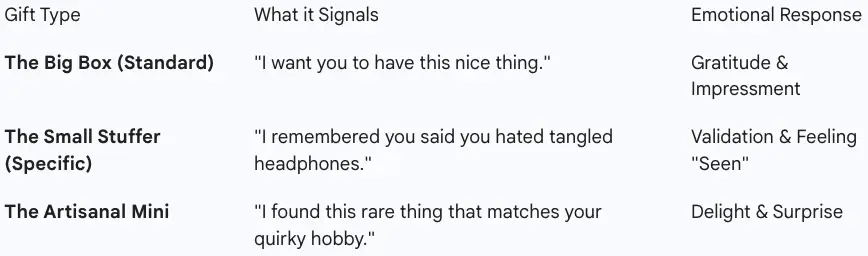
When you search for “unique stocking stuffers for adults” or “thoughtful miniature gifts,” you are looking for tools of validation. You are looking for a way to say, “I see you,” without having to say a word.
4. The Power of “Low Pressure” Gifting
We rarely talk about the “burden” of a large gift, but it exists. When someone receives an obviously expensive or massive gift, there is a subconscious social pressure to “match” that energy. This can lead to a feeling of debt rather than pure joy.
Small gifts bypass this entirely. Because they are seen as “tokens” or “treats,” the recipient is free to enjoy them without the weight of reciprocity. This allows for a much purer emotional exchange. It’s the difference between a formal five-course gala (big gift) and an unexpected, perfect cup of coffee from a friend (small gift). Which one makes you feel more relaxed and genuinely cared for?
5. SEO Spotlight: Categories That Pack the Most Punch
If you’re looking to maximize the emotional ROI (Return on Investment) of your next gift, here are the categories that science suggests work best:
Tactile Wonders (The “Touch” Factor)
Items with weight and texture ground us in the present moment.
- Keywords: Fidget stones for anxiety, solid metal worry coins, heavy-duty pocket tools.
- Why it works: Physical weight is often subconsciously equated with “importance” and “value” in the human brain.
Olfactory Anchors (The “Scent” Factor)
The olfactory bulb is directly connected to the amygdala and hippocampus (the areas of the brain that handle emotion and memory).
- Keywords: Travel-sized solid colognes, luxury essential oil rollers, botanical shower steamers.
- Why it works: A specific scent can trigger a memory of a person or a place more vividly than a photograph.
The “Aha!” Utility (The “Problem Solver”)
Gifts that solve a “micro-pain” create an immediate sense of relief and gratitude.
- Keywords: Compact screen cleaners, portable stain removers, credit-card-sized multi-tools.
- Why it works: You are saving the recipient time and frustration, which are two of our most valuable non-renewable resources.

6. Curating Your Own “Extraordinary” Collection
How do you apply this science without getting a PhD? It’s simpler than you think. When you’re browsing our site or clicking through our curated recommendations, use the “Smile Test”:
- Does it serve a specific habit? (e.g., “They always lose their chapstick.”)
- Does it feel better than it looks? (e.g., “This is made of cold-pressed steel, not plastic.”)
- Is it a ‘best-in-class’ version of a small thing? (e.g., “The world’s best pencil.”)
By focusing on these criteria, you ensure that even the tiniest box contains a massive amount of emotional weight. You stop being a “consumer” and start being a “curator of joy.”
Final Thoughts: Small is the New Big
The next time you’re worried that your gift isn’t “enough” because it fits in a mailing envelope or a knit stocking, remember the science. Your recipient’s brain isn’t looking for a line item on a balance sheet; it’s looking for a spark of dopamine, a sense of being known, and a tactile reminder that they aren’t alone.
In the world of gifting, being “extraordinary” doesn’t require a huge budget—it just requires a big heart and a very small box.
Ready to Put the Science to the Test?
Browse our latest collection of [Emotionally Impactful Miniatures] or check out our guide on [How to Pick the Perfect ‘Just Because’ Gift]. Let’s find something small that makes a massive impact.
If you’re looking to save some extra cash I always recommend planning ahead and watching for big sales at times of the year like Black Friday, Cyber Monday and Boxing Day. Major discounts can also be found after the related season comes to a close and I always recommend keeping an eye out for Amazon Prime Day Deals as those can offer big savings too!
As an Amazon Associate I earn from qualifying purchases.
last updated April