Heading back to school brings a mix of emotions. I always remember that excitement of fresh notebooks, seeing friends again, and getting back into a routine. There’s also that little bit of nervousness about what’s coming up. Having a plan helps a ton to shake off some of those nerves and start the year feeling put together instead of stressed. Here’s my all-in-one, practical back-to-school checklist with everything I make sure is sorted, from must-have supplies to routines and tech essentials.
A pre school “stocking” can be an exciting way to start the year with all of your supplies in one place (new and old). Kids usually love pulling out all of their supplies and starting the year feeling organized. They key here is ending the previous year with all supplies going into the stocking so that come August you know exactly what is needed, and what you already have to use again! With strong organization to reuse supplies and a little attention to your shopping cart prepping for back to school can be budget friendly when it comes to both supplies and back to school clothes. Here’s to the power of back to school supplies and setting your kids up for success!
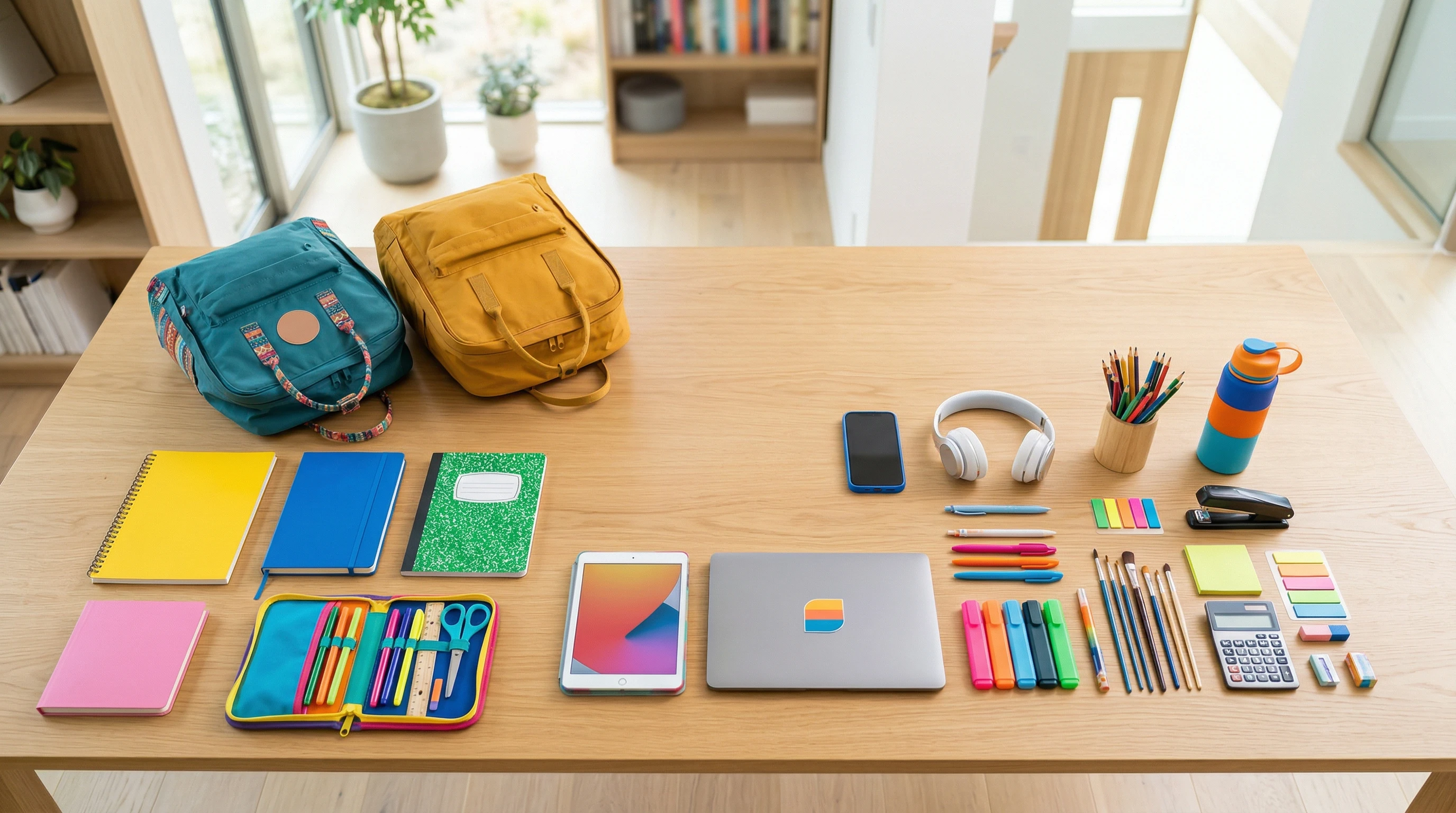
Must-Have School Supplies
Stocking up on the basics takes some pressure off that first week. Some supplies are standard nearly everywhere, but a few extra additions go a long way for more organized and productive days. Double-check your school’s supply list if you have one, but these are the essentials I always count on:
As an Amazon Associate I earn from qualifying purchases.
- Notebooks and Folders: Keeping notes sorted for each subject saves a lot of hassle later. These are often cheapest to buy in bulk while they’re on sale so stocking up early can be very beneficial.
Sometimes the just before school shopping is a lot of fun, so I try to save one notebook, folder, or binder for that time that can be picked out with exactly the design and quality desired, but the rest get pre-purchased ahead and added to the pre school stocking before any last minute shopping happens.
When going with plain notebooks they can often be found for under $4 a piece, and that gets even cheaper if you buy a large package of them – most end up thrown out or not quite finished anyways, so for the bulk of subjects those ones will do just fine. It’s important to note what size is needed – A5 is often cheaper and easier to carry around if a full 8.5″ x 11 isn’t required. For most kids that are comfortable printing within the normal line size and not yet into university science subjects they are a good compromise between enough space to write and keeping their backpack from weighing 100 lbs on the walk home. Most schools will send a list of what is needed for the upcoming year and may specify notebook size depending on the grade.
For artistic kids these ones are a favourite of mine because they tend to fill the cover edge to edge with the subject title and their own drawings. For less than $1.60 a piece (at the time of the last edit) this package of 36 A5 spiral bound notebooks can get you through several school seasons, and/or a few kids while still bringing some colour variety. - Pens, Pencils, and Highlighters: I usually keep extras in my bag because one will always disappear. A small back up stash at home is never a bad idea. Like with the notebooks, I tend to bulk buy the pens, pencils, and highlighters, and then when the year allows it kids can pick out a special pen or colourful set to help liven up their notes.
After a few too many lids that were lost or chewed on I now like to go for good but economical ballpoint retractable pens in black, blue, and red.
If I was really on a budget I’d probably keep pencils to the standard wooden ones with a small sharpener to go with them. In years where upgrades are an option some kids really like the mechanical ones with refillable lead and you can get the lead in different colours to double as their “special set” to liven up some study notes.
Highlighters probably have the most variety of these items and I personally really like something that is extra bright and doesn’t bleed too much. The crayon ones have also been useful for me in the past but, I do like the standard style better than having waxy sections on the page. - Binder or Accordion Folder: Super handy for older students with a lot of handouts. Binders come in all shapes and sizes, and depending on how much of the course content is now online they may or may not be needed. I personally like to hand write and read off of paper rather than a screen when possible so binders are a must have for me. I tend to lean toward the hard sided ones rather than the fabric zip up because it means less sheets get left inside loose and messy, but if your kid has a knack for spilling liquids in their bag then a full zip may be helpful.
Nothing bothers me more than a binder I can’t find something in so I love dividers and cover slips (sheet protectors) for splitting up sections and keeping important pages easy to pick out. Plastic dividers are my personal preference, but I have used the thick coloured paper ones in the past too and they did the job. - Sticky Notes and Index Cards: Perfect for quick reminders and last-minute flashcards. You can never have too many sticky notes or index cards, just keep in mind that index cards do need a little holder or ring to keep them together or they tend to disappear quickly. I usually go for a ring and folder combination so they don’t get bend in a backpack.
- Ruler, Calculator, and Scissors: Pretty decent to have in your bag even if you don’t use them daily. Scissors with blunt ends for safety are ideal, and a basic calculator works for the early grades but a scientific calculator is often needed later on, along with a geometry set instead of just a ruler.
- Art Supplies: If you (or your future student) are taking art, this might be coloured pencils, markers, or special paper. The options here are unlimited to look at what is actually needed, what sparks creativity, and what is practically affordable for your situation.
Some schools request tissues, hand sanitizer, or disinfectant wipes for the classroom, and I always try to have a personal stash, too. A sturdy backpack with enough pockets makes life easier, especially for carrying everything without things getting lost at the bottom. While there are plenty available online, sometimes the backpack really is best to buy in person so that you can have a good look through the pockets available, stitching quality, size against your kid, comfort features, and overall fit.

Setting Up Your Study Space
Having a study zone at home, even if it’s just a small corner, helps keep homework and projects from taking over the kitchen table. Nothing but studying and work gets done in this space so they the body learns to get into gear quickly when sitting down there.
Here’s how I set mine up for max focus and comfort:
- Good Lighting: A desk lamp or good wall light keeps eye strain away and can help students stay alert during late-night cram sessions when something inevitably didn’t get finished as early as planned. While desk lamps are probably more popular overall, I much prefer the wall lights (even if it’s of the battery stick on variety) so that my full desk space is available – there’s nothing worse then old clutter on your new clutter or a freshly cleaned space that feels claustrophobic.
- Desk Space: a flat surface to write on and spread out a few notes goes a long way. There are lots of upscale options but a cheap desk or even homemade one can do the trick too. As an adult I value a desk with the standing option, but as a kid I was perfectly happy to sit the whole time.
- Comfy Chair: Not fancy, just supportive enough for longer textbook reading or homework sprints. I love a big comfy chair with a blanket to read a good book, but a basic office chair is a better fit for the work station.
- Charging Spot: Creating a spot to keep my laptop, tablet, or phone charged keeps tech ready for school projects. This can be a shelf above the desk, drawer within it, or simply a spot on the desk that has easy access to a wall outlet. I like the stand up extension tower stations with surge protection or an itemized one for smaller electronics (having both standard wall plug and USB/USB-C options is important to me).
- Supplies Within Reach: I keep pens, post-its, and my planner right on the desk or easily accessible in the top drawer. This keeps me from getting up and getting distracted which means the planned task gets done faster.
Try to minimize clutter if you can, and consider adding a whiteboard or cork board. It’s pretty useful for tracking assignments or pinning up reminders. If you want to give the study space a bit more personality, add a small plant, a favourite photo, or motivational quote to keep spirits up during tougher assignments.

Organizational Tools That Make Life Easier
Organization isn’t usually the part anyone gets excited about, but the payoff is real. I use a combo of digital and old school tools to keep on track:
- Planner or Calendar: Paper planners are my favourite for seeing everything in one spot, but calendar apps like Google Calendar can remind you before something is due. I haven’t fully switched to a digital planner yet and love picking on out at Indigo each year along with keeping some running lists and trackers on my desk. This habit tracker is my favourite to track cleaning, studying, stretching, reading, and walking the dog on and see the progress in full colour!
- Color Coding: Using different colour pens or highlighters within each subject helps me spot key notes faster. I like to make up a system and stick with it for the year.
- Task Lists: Simple checklists, either on paper or your phone, make it satisfying to tick off what’s done. I’m a paper girl through and through but have also bene known to text myself an important reminder and leave it unread as a constant annoyance until I get it done.
Staying organized really helps when assignments start to pile up, and you don’t want to realize at midnight that an essay is due tomorrow morning. If you find yourself overwhelmed, set aside ten minutes at the end of the week to check in and adjust your system as needed. Sometimes just a quick update can make the upcoming week feel a lot more manageable.
Tech Essentials for School
Tech gear is becoming more and more important each year. Even if most assignments are still on paper, these basics keep things running smoothly:
- Laptop or Tablet: Useful for researching, writing assignments, and sometimes even textbooks are now digital. You can now get ones that easily let you limit access to websites and apps so that school time is school time and personal screen time is separate. Thankfully, over the past decade some much more affordable options have come out that still do the job well for basic school work!
- Headphones: Great for online learning, listening to videos, or just blocking out noise to study. I have two sets, one discreet pair that is nice to workout in or while listening back a short lecture, and one of the larger noise cancelling pairs that look a bit like earmuffs but are much more comfortable for extended listening. There are some top of the line options out there but all of mine have been fairly cheap and still more than sufficient for the tasks at hand.
- Chargers and Power Banks: Having an extra charger or portable battery comes in handy after a long day of classes and after school activities. I like the little black rectangle ones for their small size and ability to hold an extended charge, some of them even have the cords pre-attached and able to tuck away so you don’t have to remember that separately. Call it being well prepared, paranoid, or the ADHD tax – regardless of the name the effect of having a power bank available is usually positive.
- Cloud Storage or USB Drive: Saving work in the cloud (like Google Drive) keeps your files safe from the dreaded “my computer died” disaster. I use a combination with some things in the cloud and any more sensitive documents only on my physical back up drives. I find the best USB drives for kids have a strong hard case and a little hole in one corner that a little string or cord can be run through to attach it to something inside the backpack so it doesn’t get lost.
- Printer Access: Not everyone prints homework, but teachers sometimes want things on paper. Knowing where and how to print is helpful. There are some fairly economical printers these days, but if you don’t want one in the home or can’t justify it for the amount of use then most public libraries have printing options available as do many schools. There are plenty of printer options these days, many available for under $50!
If you’re on a budget, check for student discounts or refurbished options, and always double-check any tech requirements your school gives out. Don’t forget to organize your digital files, too. Making specific folders for each class or project helps you spot everything faster and avoid digital chaos.
Health and Wellness for the School Year
Back to school isn’t just about academics. Keeping your health in check is seriously important for staying energized and feeling your best:
- Reusable Water Bottle: Staying hydrated gives a boost to focus, plus it’s better for the planet than plastic bottles – you’ll never run out and it saves the environment. A basic one that is frequently washed well will do, but there are also some great antimicrobial options out there that may stay cleaner longer and various levels of insulation can keep your water cool longer if that’s how you like to drink it.
- Sneakers and Gym Clothes: PE and after school activities run smoother when you’ve got the right gear in your bag. Gym clothes can be pretty basic but if you do a lot of running good shoes are generally something worth investing in.
- Healthy Snacks: I pack granola bars, fruit, or crackers to keep from getting hangry by mid afternoon. Nut free is generally safest these days, they’re a great source of protein but allergies are rampant and there are many other options that may be safer for the people around you.
- Mask and Hand Sanitizer: Still good to have on hand, especially in crowded hallways.
- Medication and Allergy Info: Having an extra copy of medical needs (like inhalers or EpiPens) at school and letting a teacher or nurse know can really help in an emergency.
Don’t ignore mental health. Starting the year with a few coping tools and knowing who you can talk to—counsellors, teachers, or a trusted adult—makes a big difference. For many students, joining a club, sport, or group can help relieve stress and build connections, turning anxiety into excitement. Keeping a journal is usually a good outlet as well no matter what your age.
Other areas to keep in mind include packing a nutritious lunch and nutrition break snacks. Check out some of our other articles for eco-friendly lunch accessories and lunch pails that are both functional and fashionable.
School Forms and Paperwork
This part is easy to forget but super important for getting a smooth start. Always look out for forms and online registrations in August:
- Emergency Contacts: Double-check numbers and info for family and anyone else who can help if you (or your child) get sick at school.
- Medical and Immunization Records: Some schools won’t let you attend without them signed and up to date.
- Transportation Forms: Whether it’s a bus pass or carpool permission, I always sort out my ride plans before the first day.
- Fee Payments: Textbooks, activities, sports—there can usually a stack of things to pay for depending on the school and grade. I keep all my receipts just in case something gets missed in the system.
Most schools have online portals now, so it’s important to check email every few days in August to make sure you don’t miss anything time sensitive. Parents or guardians might want to check their own email accounts, too, along with age appropriate students monitoring their own, since some updates may go to one or the other.
First Day Prep Checklist
Packing for the first day, I always do a runthrough the night before so nothing gets forgotten in the morning rush. Here are my top items:
- Fully Packed Bag: Notebooks, pens, snacks, water bottle, and any special supplies for electives.
- First-Day Outfit or P.E. Clothes: Lay out clothes ahead of time (mom tip: avoiding early-morning panic and make sure your kid has also seen the outfit ahead and is keen to put it on).
- Class Schedule and Map: Printed or saved on my phone for quick reference, along with a printed version to stay with the student.
- Lunch or Lunch Money: Whether you buy or bring, it’s easy to forget if you’re nervous.
- Locker Info: Code written down somewhere safe. If lockers are allowed, try a couple of test opens to avoid holding up the line. If it’s bring your own lock make sure the student knows how to use it – straight number codes are often easier than the spin locks for young students just learning.
This is when routines really start. I set an alarm and get up early enough to make and eat breakfast, so we’re not running out the door in total chaos. For the first week, having a checklist on your bedroom wall or bathroom mirror helps you spot what you need before you leave.

Helpful Tips for a Smoother Start
After years of prepping for back to school, I’ve picked up a few habits that always make the first few weeks feel easier:
- Ease Into Self care Routines: Switching from summer sleep-ins to early wake-ups is rough, so I start moving bedtime earlier a week before school.
- Practice Your Commute: Walking or biking your school route ahead of time helps you get a sense for timing and where the best coffee or snack spots are.
- Connect With Classmates: Reaching out before the first day can help ease nerves, especially if you’re new.
Little things like these help set a less stressful tone and make the year feel more manageable right off the bat. Making it a point to organize a group chat with classmates or go over the school’s website can also help you stay in the loop for upcoming events, schedule changes, and announcements.
Common Questions About Getting Ready for School
Here are a few questions I get from friends every year. Thought I’d run through them in case you’re wondering, too.
Q: What’s the best way to keep from forgetting stuff every morning?
A: I pack bags the night before and make a checklist. Having a launch pad (one place to put your things for the morning) helps a lot. You could also stick a bright note by the door as a last-minute reminder—sometimes simple tricks save the day.
Q: How do I stay organized (or help keep my kids organized) with so many different subjects?
A: Color coding folders and notebooks really helps. Some people like separate binders, others love accordion folders because all the papers stay together. If you’re a digital learner, set up folders for each subject and pin important deadlines on your phone calendar so you spot them in time.
Q: What if I (or they) have trouble making friends or feel nervous?
A: You’re honestly not alone. Most people feel the same. Try to smile and introduce yourself to people sitting near, or join a club or activity where you know you’ll share interests with others. It gets easier after the first week. If you need to, ask a teacher or counsellor for ideas; they often know about casual meetups or groups that might not be widely advertised. A good teacher or support staff also probably has a good feel for the kids and can help pair bond like minded kids for activities which can be a great way to kickstart a new friendship!
Ready for a Great School Year
A solid back to school plan puts you on track for a year that’s less stressful and more fun. Getting your supplies, tech, and routines sorted early on helps you manage surprises and focus on what matters: learning, friendships, and a few new adventures along the way. Here’s to a school year that brings a fresh start, cool opportunities, and plenty of reward for all your hard work. Don’t forget to have fun, ask questions, and enjoy every bit of this new ride!
If you’re looking to save some extra cash I always recommend planning ahead and watching for big sales at times of the year like Black Friday, Cyber Monday and Boxing Day. Major discounts can also be found after the related season comes to a close and I always recommend keeping an eye out for Amazon Prime Day Deals as those can offer big savings too!
As an Amazon Associate I earn from qualifying purchases.
Last updated August 2026